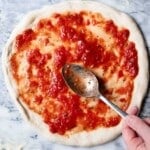
Homemade Pizza Dough
A super easy and delicious homemade pizza dough made at 65% hydration for easy handling. Make this in a stand mixer or by hand.
Servings: 4 10-12 inch pizzas
Equipment
- stand mixer with dough hook
- 4 bowls (I use cereal bowls) for refrigerating the dough
Ingredients
- 580 g Italian 00 flour (about 4 cups plus 3 tablespoons)
- 377 ml water (1 and ½ cups plus 2 tablespoons)
- 1 g dried instant yeast (¼ teaspoon)
- 12 g fine salt (1.5 teaspoons)
- Semola Rimancinata or fine cornmeal for dusting
Instructions
- Put the flour, yeast and water (do not add the salt yet) in the bowl of a stand mixer with a dough hook attached. Mix until the ingredients are fully incorporated and a dough has formed.
- Cover the bowl with plastic wrap and let it rest for 30 minutes.
Add salt, knead, proof
- Sprinkle the salt over the dough and knead with the dough hook for 10 minutes (keep it on a low speed unless you have a strong machine).
- Tip the dough onto a clean work surface and shape it into a ball. I do this by cupping my hands around the dough and gently turning it to form a ball. Place the dough back in the bowl and cover with plastic wrap. Let it proof for 4 hours or until doubled in size.
Shape and cold ferment
- Tip the dough onto a clean work surface and cut it into 4 quarters. I like to weigh my pieces of dough to between 235-240g but you don't have to do this.
- Take one piece of dough, gently pull the edges in towards the centre, then turn it over so the seam is underneath. Cup your hands around the dough and gently turn it on the work surface until it forms a smooth ball. Place it in a small bowl then repeat the process with all 4 pieces of dough, placing them in individual bowls, and then cover them in plastic wrap.
- Tip: the dough will be sticky but not unworkable. If you find it difficult to work with then you can dust your hands with a little flour.
- Place the dough in the fridge to cold ferment for 18 to 48 hours.
Shape pizzas and bake
- Bring the dough out of the fridge 2-3 hours before baking so it's not too cold.
- Preheat your oven to the highest temperature it will go. We use a pizza stone, which must be placed in a cold oven and preheated for 45 minutes to 1 hour.
- Sprinkle a generous handful of semola flour on a clean work surface and tip one dough ball directly on top of it. Flip it over so both sides are covered in semola. Next press your fingers 1/2 inch away from the edge of the dough to the other side. Do this a few times until it resembles a small pizza base.
- Pick the dough up by the edge and gently turn it in a circle, letting gravity stretch it slightly. You can also do this with your fists (see photos 13 and 14 for a visual representation).
- Now, spread tomato sauce over the base, followed by mozzarella and your choice of topping (don’t put too much on - less is more).
- Get your pizza peel ready and quickly transfer the base to the peel. Place on your pizza stone and bake for 7-10 minutes or until the crust is golden and cheese is melted.
If you don’t have a pizza peel or stone
- You can make pizzas in large baking trays instead. Just make sure to dust the tray with semola or cornmeal and transfer the pizza base to the tray before adding your sauce and toppings.
Notes
- No stand mixer? If you don't have a stand mixer, that's no problem, you can knead the dough by hand for 10 minutes instead.
- Portion sizes - this recipe makes four 10-12 inch pizzas, or you can make 2 large tray pizzas on baking trays.
- Pizza stone/steel - I highly recommend using a pizza stone or baking steel for a crispy base. The stone will need to be placed in a cold oven and then preheated. It will need at least 45 minutes to 1 hour for the heat to fully penetrate the stone.
- Pizza peel - I also love using a pizza peel. They are fairly inexpensive and make transferring the pizzas to and from the oven so easy.
- Don’t overload - it’s important that you don’t overload your pizzas with too many toppings (including sauce) or you’ll end up with soggy pizza.
- Mozzarella - We love to use fresh mozzarella and blot it dry with kitchen paper before putting on our pizzas. You can also use a low-moisture mozzarella if you prefer (usually sold in blocks).
Nutrition
Calories: 418kcal | Carbohydrates: 79g | Protein: 17g | Fat: 3g | Saturated Fat: 0.5g | Polyunsaturated Fat: 1g | Monounsaturated Fat: 0.4g | Cholesterol: 106mg | Sodium: 1205mg | Potassium: 262mg | Fiber: 0.1g | Vitamin A: 68IU | Calcium: 25mg | Iron: 5mg
