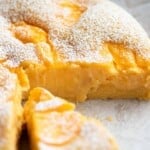
Torta Nua (Italian Cake with Pastry Cream)
Use the camera icon to toggle the step by step photos on and off. Torta Nua, a delicious Italian sponge cake flavoured with vanilla and lemon and filled with a delicious lemon pastry cream.
Servings: 12 servings
Equipment
- 9-inch loose bottom springform cake pan
- Baking parchment
- Sieve
- Stand mixer or electric hand whisk
- Plastic wrap (cling film)
Ingredients
For the Crema pasticcera
- 3 large egg yolks (I use golden yolks but this is not necessary)
- 355 ml (1.5 cups) whole milk
- Peel of 1 lemon
- 30 g (1/4 cup) cornstarch
- 50 g (1/4 cup) sugar
- 1 teaspoon vanilla extract
For the Cake
- 280 g (2 cups) Italian 00 flour (can also use all-purpose flour)
- 115 g (1 stick) unsalted butter melted
- 2 teaspoons baking powder
- 4 large eggs
- 180 g (3/4 cup plus 2 tablespoons) caster/superfine sugar (can also use granulated)
- Zest of 1 lemon
- 120 ml (1/2 cup) whole milk
- Powdered/icing sugar for dusting on top
Instructions
To make the pastry cream
- Peel the lemon in strips using a vegetable peeler and place it in a large saucepan with the milk and vanilla extract. Heat the milk until it just starts to simmer then turn off the heat immediately (photo 1).
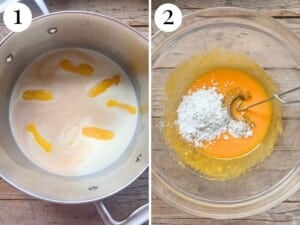
- Meanwhile, in a large bowl, combine the egg yolks, sugar and cornstarch and whisk until smooth and combined (photo 2).
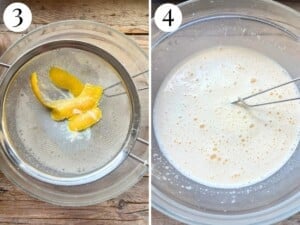
- Add a splash of the hot milk to the egg mixture and whisk it in. Place a sieve over the bowl and pour in the remaining milk, straining out the lemon peel. Give it a good whisk to avoid the eggs overcooking (photos 3 and 4).
- Pour the mixture back into the large saucepan you heated the milk in and heat on a medium-low heat until very thick. I use a wooden spoon until I can feel the pastry cream starting to thicken, then switch to a hand whisk to avoid any lumps.
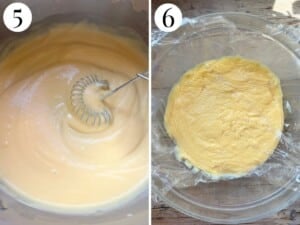
- Pour the pastry cream into a clean bowl and cover it with plastic wrap, directly on top of the cream to stop a skin from forming. Let it cool for 20-30 minutes (photos 5 and 6).
Tip: Pastry cream can take a while if the heat isn’t high enough. If it hasn’t started to thicken after 5 minutes, turn the heat up, but watch for lumps and use a hand whisk as soon as you feel it thickening.
To make the cake
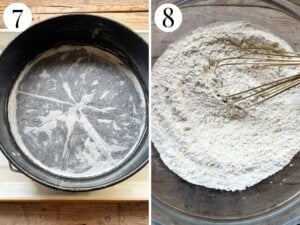
- Preheat the oven to 180C (350F) static (non-fan oven). Grease your cake pan with butter and line the bottom with parchment paper. Place the cake pan on a baking tray and set aside (photo 7).
- Melt the butter in a saucepan and let it cool (warm is fine, just not hot). Warm the milk in a separate saucepan so it’s not fridge cold; it should be tepid and not hot.
- Add the flour and baking powder to a bowl and give it a quick whisk to aerate it (photo 8).
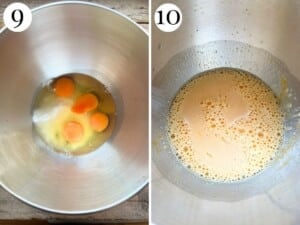
- Put the eggs, sugar and lemon zest to a the bowl of a stand mixer (or use a large mixing bowl and an electric hand whisk). Beat with the whisk attachment on medium speed. Once the mixture combines, continue to beat it for 2 minutes; it should be frothy (photos 9 and 10).
- Next, add the melted butter and whisk it in, followed by the milk.
- While whisking, add the flour and baking powder a spoonful at a time until it is all used up. Whisk for a few seconds until thoroughly combined (make sure to scrape down the sides of any excess flour and whisk it in) (photo 11).
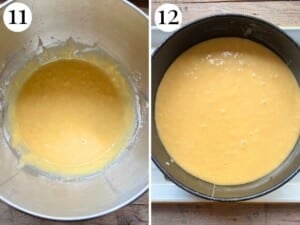
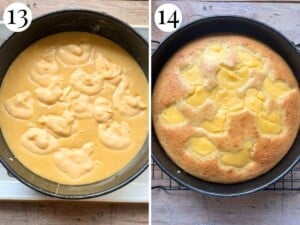
- Pour the batter into your prepared cake pan, then dollop over spoonfuls of pastry cream. I use roughly 2 tablespoons of pastry cream per dollop and place them in a circle around the outside, then in the middle (photos 12 and 13).
- Bake in the oven for 35 minutes (check with a skewer inserted into the sponge). Remove from the oven and let it sit for 10 minutes before removing the springform ring (if using) (photo 14).
- Once completely cool and just before serving, dust some powdered sugar over the top, cut into slices and serve.
Notes
- Use a kitchen scale: although I have provided US cup measurements which I have measured myself during the testing process, I've found that this cake isn't very forgiving of any incorrect measurements, so I highly recommend that you use a kitchen scale.
- Milk and butter temperature: make sure both the melted butter and milk are either warm or at room temp. Don't put hot liquid into the cake.
- Cooling the pastry cream: It's ok to use warm pastry cream but again not piping hot, so I recommend cooling the pastry cream for at least 20-30 minutes before using.
- Storage: The cake will keep well in a cool place, out of direct sunlight, for up to 2 days, then should be refrigerated. Cakes can dry out in the fridge, so the cake is at its best in the first 1-2 days.
- I don't recommend freezing.
Nutrition
Calories: 244kcal | Carbohydrates: 37g | Protein: 8g | Fat: 7g | Saturated Fat: 3g | Polyunsaturated Fat: 1g | Monounsaturated Fat: 3g | Trans Fat: 0.01g | Cholesterol: 233mg | Sodium: 123mg | Potassium: 140mg | Fiber: 0.02g | Sugar: 21g | Vitamin A: 365IU | Calcium: 119mg | Iron: 2mg
